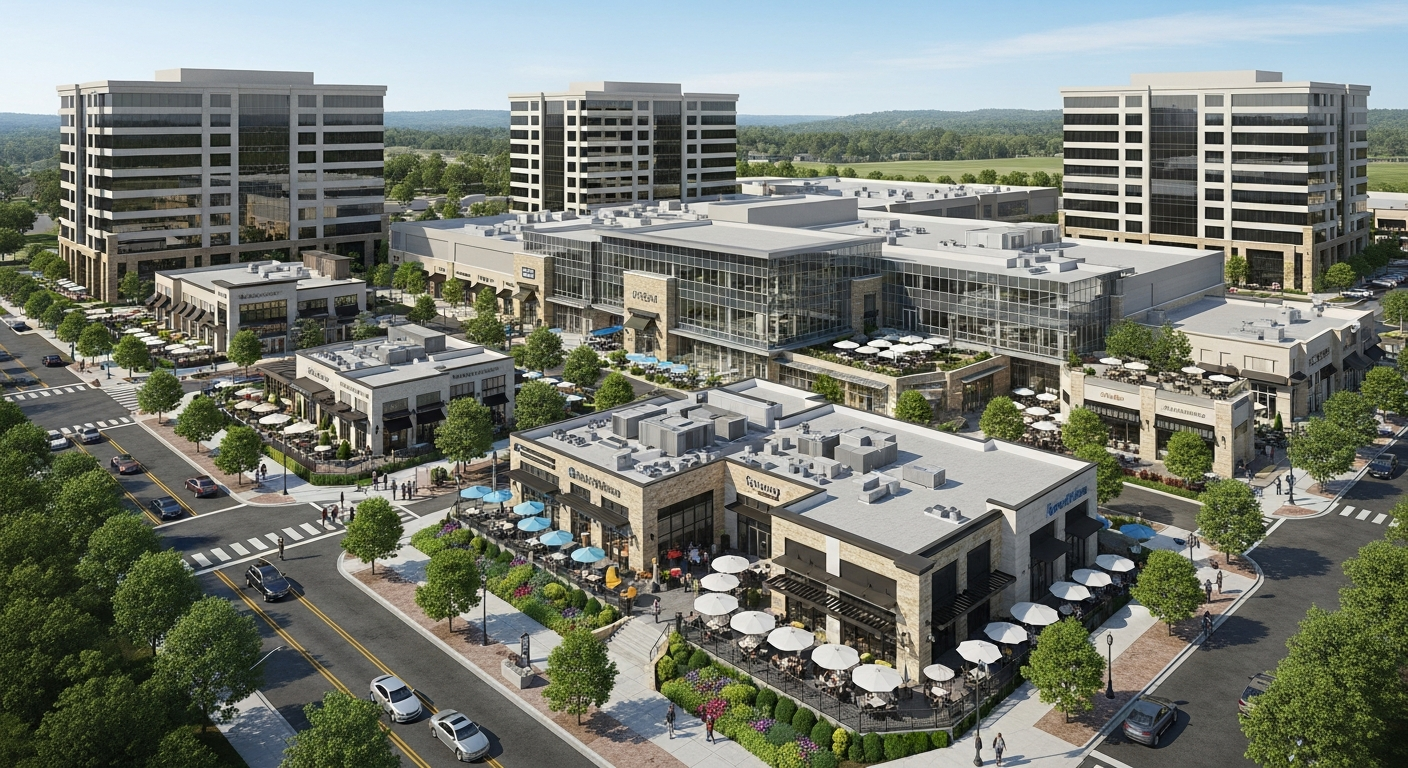
Cool Springs is difficult to describe as a neighborhood because it's not exactly one. It's a zone — the commercial and corporate corridor along I-65 in central Franklin, roughly bounded by Wilson Pike to the north and Moore's Lane to the south. It's where most of Williamson County's corporate headquarters cluster, where major retail concentrates, and where a specific kind of suburban living has emerged.
Understanding Cool Springs means understanding that you're not buying into a master-planned community or an intentional neighborhood. You're buying into a corridor that's genuinely functional, genuinely convenient, and genuinely lacking in the "charm" that characterizes other Franklin neighborhoods.
Here's what Cool Springs actually is.
The Zone, Not the Neighborhood
Cool Springs isn't a defined residential community with HOA boundaries. It's a geographic area where multiple neighborhoods and commercial zones coexist. You can live in Cool Springs and technically be in neighborhoods like Bellevue Heights, Witherspoon, or unincorporated Williamson County.
This matters because there's no unified Cool Springs neighborhood character, no consistent HOA, and no integrated community programming. You're living in proximity to Cool Springs — meaning you're near the commercial corridor, near major employers, near major retail — but you're not necessarily part of a "Cool Springs community."
The Housing Market
Price Point
Cool Springs residential pricing ranges from roughly $400,000 (smaller older homes, some needing updates) to $1.2 million (newer construction, premium locations). The median is typically $550,000–$750,000.
The Housing Stock
The housing stock is incredibly varied. Older suburban homes from the 1990s coexist with new construction. Some homes are attached townhomes; others are large single-family homes on substantial lots. There's genuine diversity in housing type and age.
The Value Proposition
You're paying for convenience and proximity to employment/retail. The Cool Springs area has excellent I-65 access, major shopping, and corporate campus proximity. You're not paying for neighborhood charm, master-planned amenities, or community intentionality.
The Commercial Reality
Cool Springs is where the region's economic activity concentrates. Nissan's global headquarters. Mitsubishi Motors. Major healthcare systems. Corporate offices, retail malls, restaurants, and service businesses create an atmosphere that's functional rather than charming.
For people who work in Cool Springs, the neighborhood proximity to employment is genuinely valuable. You can live minutes from your office, eliminating significant commute time. For people working elsewhere, the commercial activity is more ambiguous — convenient shopping, but less neighborhood peace.
The Schools
Cool Springs straddles multiple school zones. Some areas are zoned to Independence High School (excellent). Others are zoned to Ravenwood or Franklin High (also excellent). Some are in Brentwood-zoned areas. Depending on exact location, you have access to genuinely strong schools, but there's no unified Cool Springs school assignment.
The Traffic Reality
I-65 and Highway 96 convergence near Cool Springs creates predictable congestion during peak hours. Morning rush (7–9 a.m.) and evening rush (4–6 p.m.) see meaningful traffic pressure. If you're driving I-65 during peak hours, expect delays.
For people working in Cool Springs, this is less of an issue — you're staying local. For people commuting elsewhere, this is worth considering.
Who Cool Springs Actually Suits
People working in the Cool Springs corridor — If your employment is here, the proximity eliminates commute time and stress. This is the primary advantage.
People prioritizing convenience over charm — If you value having Target, Whole Foods, restaurants, and services immediately accessible, Cool Springs delivers.
Budget-conscious families — With diverse housing stock and no HOA constraints, housing prices are often lower than planned communities with equivalent square footage.
People less focused on neighborhood community — If you don't need intentional neighborhood programming or unified community culture, the functional approach works.
Who Should Consider Alternatives
People seeking neighborhood identity — If community engagement and neighborhood culture matter, planned communities (Westhaven, Berry Farms) deliver this more explicitly.
People prioritizing quiet/peace — The commercial corridor creates ambient traffic noise and activity. If peace is priority, residential-only neighborhoods are better.
Families prioritizing walkable community — Cool Springs is car-dependent. Downtown Franklin or Berry Farms offer more walkability.
The Honest Assessment
Cool Springs is pragmatic. It's convenient. It's not charming. It's functional. For people working in the corridor or prioritizing logistics over ambiance, it makes sense. For people seeking neighborhood community, it's a compromise.
Unlike Westhaven or Berry Farms, Cool Springs doesn't aspire to be anything other than what it is — a commercial corridor with adjacent residential that serves the economic activity. For the right family, this clarity is actually appealing.
Related reading:
Thinking about moving to Franklin?
Relocating is a huge decision. Get in touch with a local expert who can give you the honest, unfiltered truth about living here.
Speak to a Local Expert