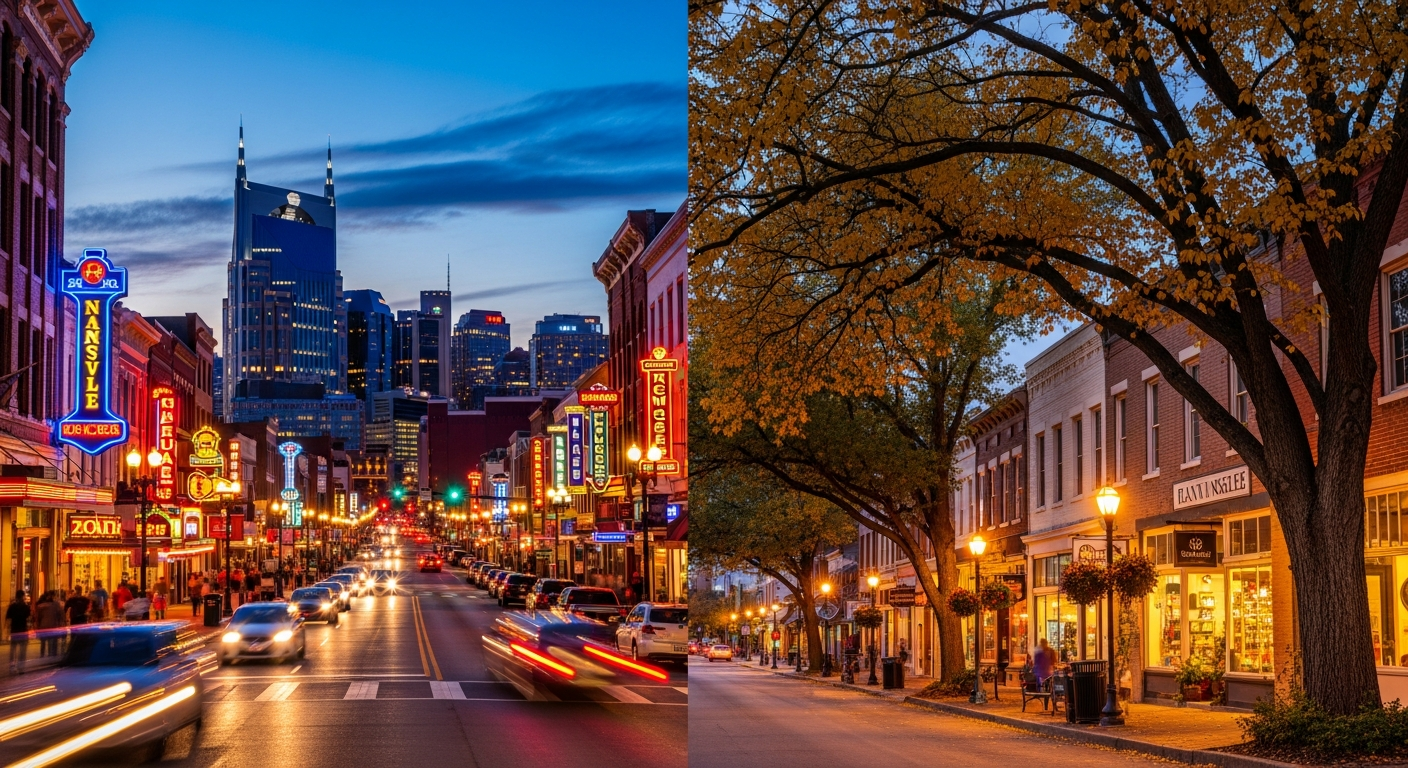
It's the first question most people ask when they're relocating to Middle Tennessee: do I live in Nashville, or do I live outside of it?
Franklin comes up immediately — it's the most prominent suburb, the most well-known, and the one most people have already heard about. But "Franklin or Nashville" isn't always a simple question. The two cities attract different people for different reasons, and the right answer depends entirely on what you're optimizing for.
This guide lays out the comparison honestly, category by category, so you can make the call with clear information.
The 30-Second Version
Choose Nashville if: You want urban density, walkable nightlife, the energy of a growing major city, and you prioritize culture and convenience over schools and quiet.
Choose Franklin if: You have children (or plan to), you prioritize safety and schools above urban amenities, you want more house for your money relative to comparable Nashville neighborhoods, and you're okay being 20–30 minutes from the city when you want it.
Most people landing on this question already know which description sounds more like them. The rest of this guide fills in the details.
Cost of Living
Housing
This comparison is more nuanced than it used to be. Nashville proper has seen dramatic price appreciation over the past decade, and many Nashville neighborhoods are now comparable to or more expensive than Franklin on a per-square-foot basis.
In general terms:
- East Nashville, 12South, Germantown, the Nations: $600,000–$1.5M+ for single-family homes, smaller lots, urban density
- Green Hills, Belle Meade: $800,000–$3M+, established and expensive
- Franklin: $450,000–$2M+, larger lots on average, more new construction options
The honest comparison: you can get more square footage and more land in Franklin for a given price point in most cases. But if walkability and neighborhood character are the priority, some Nashville neighborhoods offer something Franklin simply doesn't have — the density and energy of an urban residential neighborhood.
Taxes
Both Nashville (Davidson County) and Franklin (Williamson County) benefit from Tennessee's no-state-income-tax environment. However, Williamson County has lower property tax rates than Davidson County — meaningfully so. On an equivalent home value, Franklin buyers typically pay less in annual property taxes than Nashville buyers.
Davidson County's property tax rate runs approximately 20–25% higher than Williamson County's effective rate. On an $800,000 home, this difference can amount to $1,500–$2,500 per year.
Schools
This is the category where Franklin wins most decisively, and where the comparison is least close.
Williamson County Schools consistently ranks as the top public school district in Tennessee. Test scores, graduation rates, college placement, and teacher quality are all above state averages by significant margins.
Metro Nashville Public Schools (MNPS) serves Nashville proper and presents a far more varied picture. The district serves a much larger, more demographically diverse population, and school quality varies dramatically by neighborhood and zone. Some Nashville schools perform well; others significantly underperform state averages. For families who rely on public schools, the assignment lottery and zone system in MNPS introduces uncertainty that doesn't exist in Williamson County.
Families with children who are prioritizing public school quality and don't want to pay private school tuition have a compelling reason to choose Franklin. This single factor drives a substantial portion of Franklin's in-migration from Nashville neighborhoods.
Private school options exist in both markets — Nashville has several prestigious independent schools including Montgomery Bell Academy, Harpeth Hall, and Ensworth. For families committed to private education, Nashville's options are arguably broader. But for public school families, the comparison isn't particularly close.
Lifestyle and Neighborhood Character
Nashville
Nashville's residential neighborhoods offer something Franklin genuinely doesn't: the texture and energy of urban living.
East Nashville has developed into one of the most interesting residential neighborhoods in the South — walkable, creative, with a mix of restored craftsman homes and local businesses that gives it a real sense of place. 12South, Germantown, and the Nations each have distinct identities and genuine walkability. Living in these neighborhoods means being embedded in a city in a way that Franklin's suburban character cannot replicate.
Nashville also has the critical mass that produces a certain kind of cultural life. Live music venues, independent restaurants and bars, arts institutions, professional sports, an international airport within 20–30 minutes — Nashville proper has the infrastructure of a real city.
Franklin
Franklin's residential character is fundamentally different — more spacious, quieter, more family-oriented. The downtown Franklin experience is genuinely excellent for a small city, but it's a small city. The density of cultural options, the late-night energy, the feeling of being inside a major metropolitan area — Franklin doesn't offer that, and doesn't try to.
What Franklin offers instead is a quality of neighborhood life that Nashville's most desirable areas command a significant premium to approximate. Front porches, quiet streets, school pickup, community events, neighbors who know each other — the suburban family lifestyle, executed at a high level.
Commute and Access
If You Work in Nashville
Franklin to downtown Nashville is approximately 21 miles via I-65. In normal traffic, this is a 25–35 minute drive. During morning and evening peak hours — particularly on I-65 and I-65's merge points — this can stretch to 45–60 minutes or more.
If you're commuting to Nashville daily, the commute is real and worth experiencing before committing to a Franklin address. Drive it on a Tuesday morning at 7:45am before you decide. Some people find it completely manageable. Others find it erodes quality of life in ways that are hard to anticipate from a distance.
Franklin residents who work in Cool Springs or have flexible/remote arrangements experience this calculation very differently — the commute essentially disappears.
If You Want Nashville Occasionally
For Franklin residents who work locally or remotely and want Nashville access for concerts, dining, and events on their own schedule, the 21-mile distance is a non-issue. Driving to Nashville for a Predators game or a dinner in Germantown is easy. Being dependent on Nashville for daily work is a different calculation.
Safety
Franklin's crime rate is significantly lower than Nashville's across all major categories. This is a consistent and meaningful difference, not a marginal one.
Nashville, like most major American cities, has pockets of higher crime alongside very safe neighborhoods. The variation within Nashville is significant — East Nashville and 12South have very different safety profiles than other parts of the city. Franklin as a whole benchmarks well below national and state averages.
For families with children, this difference tends to be weighted heavily in the Franklin column.
Social Life and Community
Nashville
Nashville's social infrastructure for young professionals, creatives, and people without children is genuinely excellent. The city's growth has been accompanied by a restaurant and bar scene, music venues, and social culture that makes meeting people and building a social life relatively organic. If you're moving somewhere new without an established network, Nashville's density and social energy can accelerate community formation.
Franklin
Franklin's social infrastructure is more structured and more family-oriented. Churches, neighborhood associations, school communities, sports leagues, and HOA events are the primary on-ramps for social connection. For families with children, this works extremely well — school communities and neighborhood life create natural social structures. For single professionals or couples without children, Franklin's social scene requires more intentionality.
The Relocation Decision Framework
A few clarifying questions that tend to resolve the Franklin vs. Nashville question quickly:
- Do you have children or plan to? If yes, and public schools are a priority, Franklin's advantage is decisive.
- How important is walkability and urban energy to your daily life? If essential, Nashville. If nice-to-have, Franklin.
- Where do you work? Cool Springs, Brentwood, or southern Nashville suburbs → Franklin is obvious. Downtown Nashville core, East Nashville → Nashville is more practical.
- What do you value in a neighborhood? Density and culture → Nashville. Quiet, space, and community orientation → Franklin.
- What stage of life are you in? Pre-children, professionally ambitious, urban-oriented → Nashville often wins. Family stage, school-focused, settled → Franklin often wins.
The Honest Answer
Most people who move to Franklin from Nashville will tell you they don't miss Nashville as a place to live. They miss specific things — certain restaurants, the energy on a given street, the feeling of being inside something bigger. But the overall quality of daily life in Franklin tends to exceed what Nashville was delivering, particularly for families.
Most people who stay in Nashville do so deliberately. They value what Nashville is, they've built lives there, and the urban energy is part of the value proposition they're paying for.
Both are correct. The question is which correct answer applies to you.
Thinking about moving to Franklin?
Relocating is a huge decision. Get in touch with a local expert who can give you the honest, unfiltered truth about living here.
Speak to a Local Expert