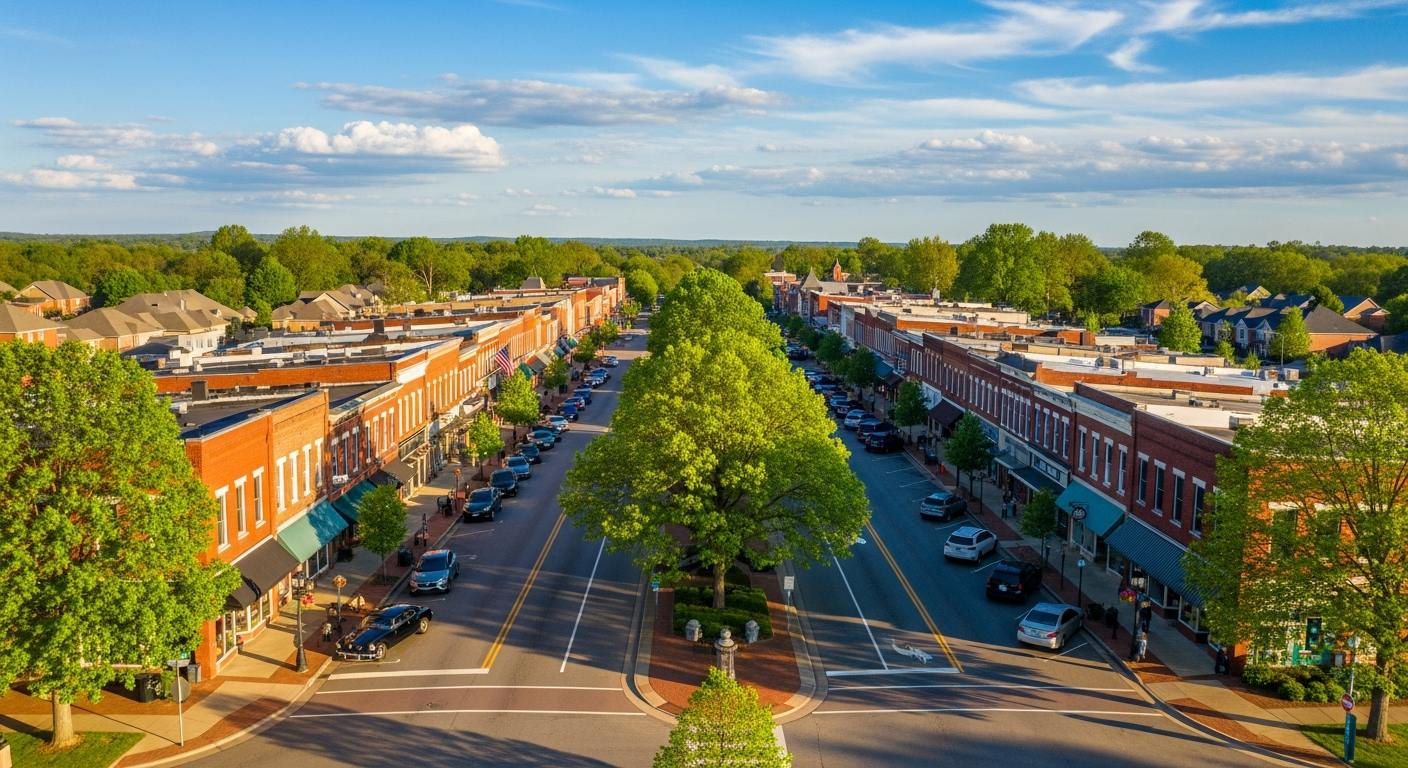
If you've been researching Williamson County for more than a week, you've run into the Franklin vs. Spring Hill question. They're 12 miles apart on I-65. Same school district pull (mostly), same general orbit, same Middle Tennessee character. But the lived experience is meaningfully different, and the right choice depends on stage of life and budget far more than aerial geography suggests.
Here's the honest local comparison, with the real trade-offs neither realtor blogs nor the city websites tell you.
The 30-second answer
Pick Franklin if you want walkable historic charm, established neighborhoods with mature trees, faster Nashville access, and you can afford the premium ($800k+ for most desirable inventory).
Pick Spring Hill if you want newer construction, more square footage and yard for the dollar, and you're comfortable with a longer commute and a town that's still figuring out what it wants to be.
Both put you in strong school districts. Both put you in Williamson County (Spring Hill straddles Williamson and Maury Counties , important detail, see below). Both feel safer, friendlier, and lower-stress than where you're coming from.
The basics: where they sit
Franklin is 25 miles south of downtown Nashville on I-65. Population around 90,000 in 2026. Williamson County seat. Historic core dating to the early 1800s. Median home price roughly $900k.
Spring Hill is another 12 miles further south on I-65 , about 37 miles from downtown Nashville. Population around 60,000 in 2026 and growing fast (one of the fastest-growing cities in Tennessee for the past decade). Predominantly newer construction. Median home price roughly $500–550k.
The corridor between them is the I-65 / Highway 31 spine, which runs through Thompson's Station , a small town between Franklin and Spring Hill that effectively functions as a third option, with character closer to Spring Hill but proximity closer to Franklin.
Schools: the most important and most misunderstood factor
Both cities are in or adjacent to Williamson County Schools , the top-rated public district in Tennessee , but the geography matters.
Franklin proper is entirely in Williamson County Schools. Strong elementary, middle, and high school options across the city.
Spring Hill straddles two counties. The Williamson County portion is in Williamson County Schools (excellent). The Maury County portion is in Maury County Public Schools, which is solid but a meaningful step down in academic outcomes and per-pupil spending. This is the single most important due-diligence question for any Spring Hill home buyer. Verify the school zone before falling in love with a house. Two homes on adjacent streets can feed completely different districts.
The high schools that draw most Williamson-side Spring Hill students are Independence and Summit , both well-regarded but not at Franklin High or Centennial's tier for arts and college matriculation.
If schools are a top-three reason for your move, Franklin proper offers more school-zone flexibility and less risk of an accidental county-line problem.
Cost of living: the gap is real
This is where Spring Hill earns most of its growth.
A 4-bedroom, 3,000 sq ft home on a quarter-acre in Spring Hill (Williamson side, good school zone): $550–650k.
The same square footage and lot in Franklin's family neighborhoods (Fieldstone Farms, McKays Mill, parts of Westhaven): $700–900k.
A premium gated community home in Spring Hill (Campbell Station, Wades Grove): $700–900k.
The premium gated equivalent in Franklin (Westhaven, Laurelbrooke): $1.1–2.5M+.
Property tax rates are similar (both Williamson at roughly 0.65–0.75% effective). Spring Hill's Maury County portion has slightly higher rates and meaningfully different services.
Sales tax: both are 9.75% (state + Williamson). Maury County is 9.75% too.
For most family budgets between $400k and $750k, Spring Hill is where the inventory lives and Franklin is where you'll pay a premium for character and proximity.
The commute reality
Franklin to downtown Nashville: 25–35 minutes most mornings, 35–45 in heavy traffic. Cool Springs (the commercial corridor on Franklin's north end) is 5–10 minutes from most Franklin homes.
Spring Hill to downtown Nashville: 40–55 minutes most mornings, frequently over an hour during peak. The bottleneck is the I-65 / I-840 interchange and the gradual narrowing south of Cool Springs. Spring Hill residents who work in Cool Springs typically have a 20–30 minute drive , manageable, but daily.
If you work in downtown Nashville and have to be at a desk by 8:30, Spring Hill will cost you 30–60 minutes more per day than Franklin. Over a year that's roughly 130–250 hours of additional commute time. This is the real cost that doesn't show up on the spreadsheet.
If you work hybrid (2–3 days in office) or remote, the commute differential matters far less.
Lifestyle and community: the underrated difference
This is the part that's hardest to convey from a tour.
Franklin has a 220-year-old downtown, a 16-block historic district on the National Register, and a community life centered on Main Street. The Franklin Theatre, Pilgrimage Festival, Main Street Festival, Dickens of a Christmas, the Farmers Market , these aren't tourist attractions, they're how locals actually spend Saturdays. Franklin functions as a town with a center.
Spring Hill is a fast-growing exurb that's still building its center. It has a Target, a movie theater, several Crossroads-style retail centers, two hospitals, and an emerging downtown around the historic Tennessee Children's Home area. It does not yet have Franklin's anchor. Spring Hill's community life is more neighborhood-centered , pool parties, HOA events, school activities, and youth sports.
This isn't a knock on Spring Hill. For families with elementary-age kids, Spring Hill's neighborhood-centric model often delivers more day-to-day community than Franklin's downtown-centric model. But if you valued downtown walkability where you came from, Franklin gives you something Spring Hill doesn't yet have.
Who Spring Hill is best for
- First-time buyers in Tennessee who want strong schools without the $800k+ entry point
- Families with younger kids who'll spend most weekends in their neighborhood, at the pool, and at youth sports fields
- Buyers who work in Cool Springs, the GM/Ultium plant, or south Nashville , the commute is reasonable
- Anyone who wants newer construction with modern floor plans, energy efficiency, and minimal renovation
- Out-of-state transplants who want Williamson County Schools but didn't budget for Franklin pricing
Who Franklin is best for
- Buyers with budgets above $800k who want a home that holds value and a town with established character
- Empty-nesters and DINKs who'll use a walkable downtown and a denser cultural calendar
- Commuters who need the shortest possible drive to Nashville
- Buyers who plan to be in the home 10+ years , Franklin's appreciation has been more stable
- Anyone who valued a real downtown where they came from , the cultural transition is easier
What both cities share
- Williamson County Schools (mostly), top-rated in Tennessee
- Tennessee's no-state-income-tax advantage
- Low crime by national suburban standards
- Strong job market (Cool Springs, Brentwood, Nashville)
- Real four-season climate without the extreme winters of the Northeast or Midwest
- Family-friendly, conservative-leaning but not monolithic, faith-active community life
- A real estate market that rewards location and school zone heavily
The Thompson's Station option (worth knowing)
Between Franklin and Spring Hill sits Thompson's Station , a small Williamson County town of about 8,000 people. Newer construction, large lots, all Williamson County Schools, with prices generally between Franklin and Spring Hill ($600–850k for family homes). Thompson's Station is increasingly the answer for buyers who want Spring Hill pricing with Franklin school certainty and a more rural feel. Communities like Tollgate Village, Bridgemore, and Canterbury are popular with this profile.
How to decide
Visit both. Drive each city at 5pm on a weekday and again on Saturday morning. The lived geography matters more than any spreadsheet. Pay attention to:
- How long the actual commute feels from the homes you're considering
- Whether the neighborhood you'd buy in feels like the neighborhood you'd live in (some Spring Hill subdivisions feel disconnected from the city; some Franklin neighborhoods feel suburban despite the address)
- The school zone, verified by the school district map, not the listing description
- Whether the trade-off , Franklin's premium for character and proximity vs. Spring Hill's value for space and newness , matches your priorities
The bottom line
Franklin and Spring Hill are not interchangeable. They're different products at different price points serving different stages of life.
Franklin is a finished town: established, characterful, expensive, anchored. Spring Hill is a growing town: newer, less expensive per square foot, still building its identity.
Most buyers I talk to think they want Franklin and end up affording Spring Hill , and most are surprised that they're happier than they expected. The opposite path also happens: buyers who came in budgeting for Spring Hill stretch to Franklin and report that the lifestyle improvement justified the spend.
The right answer is the one your budget supports without strain, and the one that matches how you'll actually spend your weekends.
Considering a move to Franklin? Talk through the details with a Franklin resident. Free 30-minute call, no pitch.
Book a free Franklin relocation call
Related reading
Considering a move to Franklin?
Talk through the details with a Franklin resident. Free 30-minute call, no pitch.