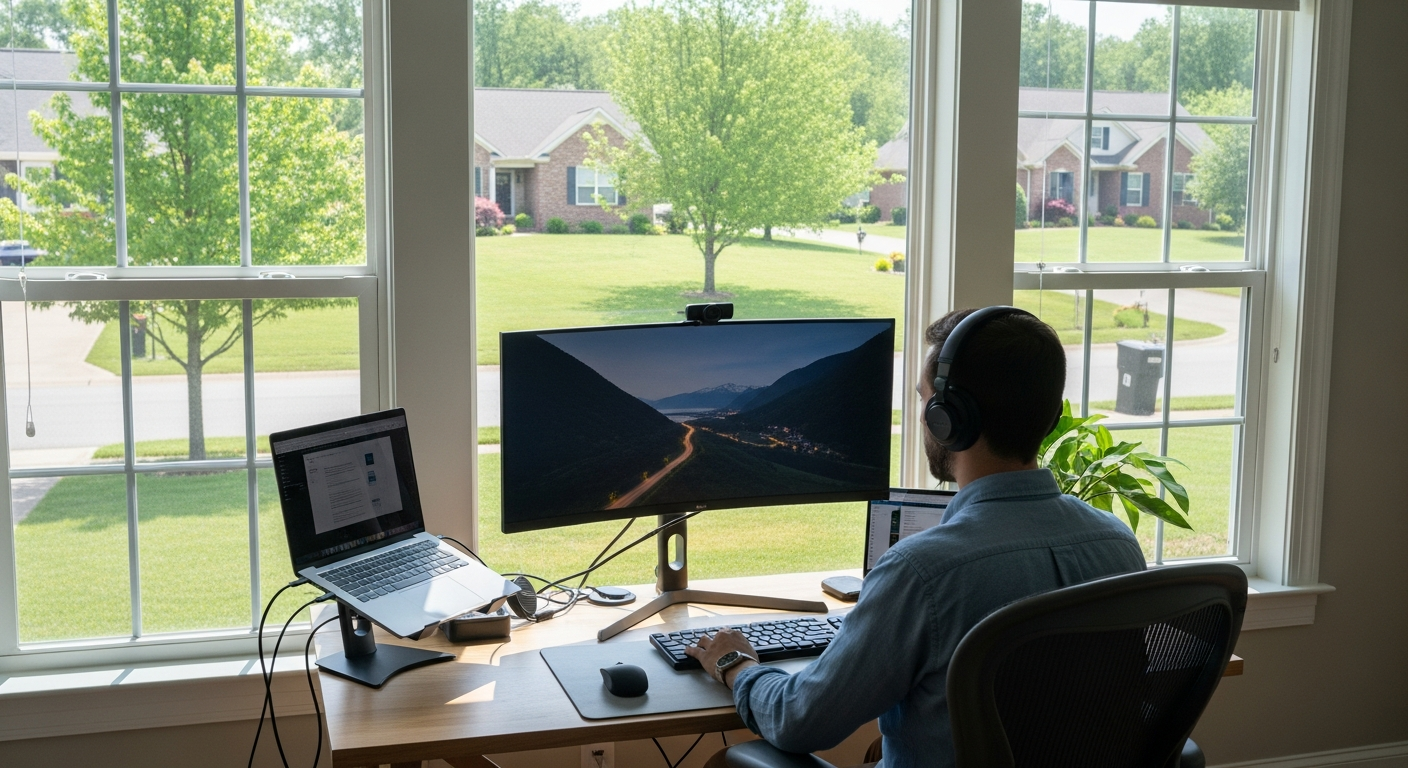
Working Remotely from Franklin, TN: The Complete Guide
Franklin is having a quiet remote-work moment. The combination of Tennessee's tax structure, Williamson County's housing quality, BNA's expanded direct-flight network, and the kind of community fabric that makes remote work sustainable rather than isolating has put Franklin on a lot of remote workers' shortlists.
Here's the honest version: who Franklin works for as a remote-work base, what the practical infrastructure actually looks like, and what to think about before you commit.
The 30-second answer
Franklin is an excellent remote-work base if:
- You don't need to be in an office regularly (true remote, or quarterly travel to HQ)
- Your employer is comfortable with Tennessee residency (some still aren't — verify before assuming)
- Your work doesn't require ultra-low-latency to a specific coast (East Coast latency is fine; West Coast is workable)
- You value real seasons, walkable downtown options, and a community life outside of work
- Your budget supports $600k+ for housing
Franklin is probably not the right answer if:
- You need to be physically present at an office in NY, SF, or LA more than monthly
- Your work requires immediate access to specialized resources (large research universities, particular industry hubs) that don't exist in Nashville
- You want a true "live downtown, walk everywhere" experience without a car (Franklin's downtown walkability is real but limited in geography)
Why remote workers are choosing Franklin
The Franklin remote-work case rests on five pillars.
Tax structure. Tennessee has no state income tax. For a remote worker earning $200k who would otherwise pay 5–13% in California, New York, or New Jersey, that's $10k–$26k saved annually. Property taxes are also low (effective ~0.5% of market value in Franklin), so the tax case extends beyond income.
Housing value. Franklin housing is more expensive than the average Tennessee market but considerably less expensive than the coastal markets most remote workers leave. A 4-bedroom home with a real office, fast fiber internet, and good natural light costs $700k–$1M in Franklin and $1.8–3M in the Bay Area, $1.5–2.5M in coastal Boston or Northern Virginia.
Connectivity. Franklin has multiple high-quality fiber providers (AT&T Fiber, Google Fiber, and several others depending on neighborhood), with gigabit service widely available. Latency to AWS us-east-1 (Northern Virginia) is excellent. Latency to AWS us-west-2 (Oregon) is workable. The infrastructure is genuinely competitive.
Travel access. BNA (Nashville International) has expanded substantially over the past decade, with direct flights to most major business hubs (NYC, DC, Boston, Chicago, Atlanta, Dallas, Denver, LA, SF, Seattle), several European cities (London, Paris, Amsterdam, Frankfurt), and growing international service. For remote workers who travel for quarterly or monthly meetings, the access is good — not Atlanta-tier, but well above small-metro standards.
Community structure. This is the underrated pillar. Remote work without community is grim. Franklin's faith communities, school networks, neighborhood programming, and small-business ecosystem make it unusually easy to plug into local life — which is what keeps remote work sustainable over a 5–10 year arc.
Internet, power, and home-office practicalities
A few things worth knowing about Franklin's digital infrastructure:
Fiber internet is widely available. Most Franklin neighborhoods have at least two fiber providers competing (AT&T, Google Fiber where available, and various others). Gigabit service is standard. 2–10 gig service is increasingly available in newer neighborhoods. Pricing is competitive — generally $80–120/month for gigabit residential.
Power reliability is excellent in most of Franklin. Williamson County is served primarily by Middle Tennessee Electric, with strong reliability metrics. Outages happen — primarily during ice events and severe thunderstorms — but extended outages are rare.
Backup considerations. Most remote-work-serious households install a small generator (5–10kW standby or a portable 5kW unit) for occasional outages. Whole-home generators are more common in luxury homes; not standard in mid-tier neighborhoods.
Cell coverage is good in Franklin proper for AT&T, Verizon, and T-Mobile. Some western Williamson County areas (Laurelbrooke, parts of Leiper's Fork) have spottier coverage; verify with your carrier.
Home office space. Most Franklin homes built in the past 15 years include a dedicated office or flex room. Older homes (pre-2010) sometimes don't, and the work-from-home market has driven significant remodeling demand. Budget for the office build-out if buying older inventory.
The work-day rhythm in Franklin
A typical Franklin remote-work day, because the geography matters:
Morning routine is generally car-light. Most Franklin neighborhoods have a coffee shop, a bagel/breakfast spot, or a small café within a 5–10 minute drive. Downtown Franklin has serious morning options (Five Daughters Bakery, Honest Coffee, Frothy Monkey, Merridee's). The drive is short. Parking is generally fine.
Mid-day workout is easy. Franklin has multiple high-quality gyms (Franklin Athletic Club, Williamson County Indoor Sports Complex, Pickleball-specific facilities, F45, Orangetheory, OneLife Fitness, and several boutique studios). Outdoor running and cycling on Natchez Trace Parkway, Harpeth River Greenway, or Franklin's growing greenway network is excellent.
Lunch options are abundant — downtown Franklin alone has 50+ locally-owned restaurants, and Cool Springs adds another 100+ within 10 minutes. Most Franklin remote workers cycle through 5–10 regular spots.
Afternoon focus blocks are easy in a Franklin home. The acoustic environment is generally quieter than dense urban living. Daytime delivery and service traffic is moderate. Most neighborhoods are well-suited to deep work.
End-of-day decompression ranges from a downtown happy hour to a Greenway walk to a backyard fire. The variety is real.
The community plug-in problem (and how to solve it)
The number one risk for remote workers anywhere — including Franklin — is isolation. Working from home five days a week, in a community where you don't have an office network, can produce a slow drift toward loneliness that often takes 12–24 months to fully recognize.
Franklin makes this easier than most places, but only if you're deliberate. Specific plug-ins that work:
Faith community. Franklin has dozens of active churches, several synagogues, and a small but real interfaith community. If religious community is part of your life, plug in within the first 90 days. The social network this generates is substantial and durable.
Sports and fitness clubs. Pickleball is a serious community sport in Franklin. The Williamson County Indoor Sports Complex, several private clubs, and a growing number of municipal courts host competitive and social play. Tennis, golf, cycling clubs, running groups, and CrossFit gyms all have active communities.
Neighborhood HOA programming. Westhaven, McKays Mill, and several other neighborhoods have active social programming — happy hours, food truck nights, holiday events. This is real community for new residents.
Volunteer and civic. Franklin's nonprofit ecosystem is active and welcoming to new volunteers. Heritage Foundation, Franklin's Charge, the local schools, GraceWorks (community services), and many others.
Coworking. Franklin has a small but real coworking sector — primarily in Cool Springs and downtown Franklin. Some remote workers do 1–2 days per week from a coworking space specifically for the social benefit.
Industry meetups. Nashville hosts substantial tech, healthcare, and creative-industry meetups within a 25-minute drive. For most remote workers, this is the easiest route to professional community.
The remote workers who thrive in Franklin almost universally plug into 2–3 of these in the first six months. The ones who don't tend to leave within two years.
Tax and employer considerations
A few things to verify before assuming Franklin works for your specific situation:
Employer state-of-residence policies. Some employers (particularly large publicly-traded companies in California or New York) have specific approval processes for out-of-state remote workers. Verify before signing a lease or making an offer. Most accommodate Tennessee residence; some don't.
State income tax for non-resident work. Tennessee has no state income tax, but if you travel to other states for work, you may owe non-resident income tax in those states for the days worked there. For most remote workers, this is a minor administrative matter; for high-traveling executives, it can be material.
Sales tax on tools and services. Tennessee's 9.75% sales tax (state + Williamson County) applies to most goods and certain services. For remote workers spending heavily on home office equipment, this is meaningful but not transformative.
Self-employment considerations. For self-employed remote workers, Tennessee's no-income-tax structure is dramatic. The Tennessee business tax (formerly Hall income tax for investment income, fully phased out in 2021) does not apply to ordinary self-employment income. There's a small annual business tax filing for certain LLCs.
Where remote workers tend to live in Franklin
Patterns in Franklin's remote-worker housing:
Westhaven is the most popular landing for remote-worker families — programmed community, pool/town center, walkable village, fiber service, plenty of inventory in the $900k–$1.5M range.
Berry Farms appeals to remote workers who want newer construction, a developing village center, and slightly more contemporary architecture.
McKays Mill, Fieldstone Farms for remote-worker families at the $600–800k tier — strong amenity packages, walkable streets, family-oriented community.
Downtown Franklin for DINKs and empty-nesters — historic homes or newer downtown condos, walkable lifestyle, real downtown life.
Laurelbrooke and Legends Ridge for the high-end remote worker (founders, executives, healthcare/music industry) — large lots, custom homes, quiet community feel.
Spring Hill, Thompson's Station, Nolensville for budget-conscious remote workers — strong fiber, lower entry price, slightly longer drive into Franklin/Nashville for in-person needs.
What's harder than expected
Time-zone coordination. Tennessee is on Central Time. If you're working with East Coast colleagues (most common), the morning meeting cadence works fine — you're up at 8 ET, they're at 9. If you're working with West Coast colleagues, 5pm meetings their time become 7pm yours. Manageable but worth modeling.
Direct flights to second-tier markets. BNA covers major hubs well. Smaller markets (Charlotte, Detroit, Cleveland, San Diego) sometimes require a connection or have limited frequencies. For remote workers who need to be flexible about specific destinations, this matters.
The summer/winter weather extremes. Working from home in August (high 90s + humidity) or January (occasional ice events) requires reliable HVAC and a backup plan. Most homes handle this fine; older homes with under-sized systems can struggle.
The "always-on" trap. Working from home in a beautiful place is dangerous if you don't set boundaries. The Franklin remote workers who thrive establish a clear daily end-of-work ritual — gym, walk, dinner — within the first month.
The bottom line
Franklin is one of the strongest remote-work destinations in the country for the right profile: someone who can take advantage of Tennessee's tax structure, who values real-community small-town life, who has the housing budget to land in a neighborhood that supports the lifestyle, and who'll be deliberate about community plug-in.
The financial math typically saves a remote-working household $15k–$40k+ annually compared with the high-tax coastal markets they're moving from. The lifestyle improvement is real for most who make the move. The risk — isolation — is mitigated by deliberate community engagement.
If that profile fits, Franklin deserves a serious look.
Considering Franklin as your remote-work base?
I live in Franklin, work as a referral agent, and have helped a number of remote-working buyers think through this move. If you want a free 30-minute call to talk through neighborhoods, internet/infrastructure, school options if relevant, and whether Franklin matches your specific work situation — book a time below.
Download the free Franklin Relocation Toolkit (PDF) →
Related reading
Thinking about moving to Franklin?
Relocating is a huge decision. Get in touch with a local expert who can give you the honest, unfiltered truth about living here.
Speak to a Local Expert